
Prefer to Listen:

In many unhealthy families, there is often one child. The child who somehow ends up being blamed for things they didn’t do, things they weren’t even part of, and sometimes simply for standing in the wrong place at the wrong time. If you’re nodding your head right now, you already know what I’m talking about.
It took me until my sixties to realize I had been living this pattern my whole life. Not just as a child, but in my marriage, my friendships, and my workplaces. Once I saw it, I couldn’t unsee it.
So, how does a family choose its scapegoat? What is it about that one child, out of all the siblings, that makes them the one who gets blamed? There are recognizable patterns in how it develops. And once you understand those patterns, you may start to recognize them in your own story too.
The Family Scapegoat Role Isn't Random: 5 Ways the Pattern Develops
Most families don’t sit down and consciously choose one person to blame. It happens gradually. One interaction builds on another until blaming the same person becomes part of how the family operates.
Here are five ways the pattern can develop.
1. You Were Different From the Rest of the Family in Some Way
The family scapegoat is often the child who stands out. Maybe you were more sensitive, expressive, independent, or outspoken than your siblings. Perhaps you noticed unfairness, questioned what was happening, or refused to pretend that everything was fine.
That does not mean there was something wrong with you. But in an unhealthy family, being different can make it easier to single you out.
Ask yourself: What made me different from the rest of my family?
2. One Controlling Person Began Treating You as the Problem
The scapegoat role often begins with one controlling person in the family. It might be a parent, grandparent, older sibling, or anyone who holds power within the family. This person may repeatedly blame you for things you didn’t do or hold you responsible for other people’s behaviour.
A double standard can develop. Your siblings’ mistakes are excused or overlooked, while yours are criticized or punished more harshly. Over time, their version of you can become the family’s accepted story, even when it doesn’t match what actually happened.
Ask yourself: Who first began treating me as though I were the problem?
3. Other Family Members Learned to Go Along With It
Once one person begins blaming you, other family members may follow. They may agree because it protects them. If everyone is focused on what is supposedly wrong with you, they don’t have to look at their own behaviour. They may also learn that supporting you could make them the next target.
Some family members may actively participate. Others may remain silent and allow it to happen. Either way, the pattern becomes stronger.
Ask yourself: Who joined in, and who stayed silent when I was blamed?
4. Your Reactions Were Used Against You
When you are repeatedly blamed or treated unfairly, you will react. You might raise your voice, storm out of the room, or try desperately to explain yourself. But instead of looking at what happened before your reaction, the family focuses only on how you responded.
They say, “See how emotional you are?” or “This is why we can’t talk to you.” Your response to being mistreated is then used as proof that you were the problem all along.
Ask yourself: Did my family focus on my reaction while ignoring what happened before it?
5. The Role Became the Family’s Permanent Story About You
After the pattern has been repeated long enough, the scapegoat role can become part of the family’s story. You may be labelled the difficult one, the selfish one, or the one who always causes trouble. These labels don’t necessarily reflect your behaviour, but they shape how the family sees you.
Even when you have done nothing wrong, family members may automatically assume you are responsible. They may continue telling the same stories about you years later while ignoring anything that challenges their version of events. Eventually, you may begin believing the story yourself.
Ask yourself: What story did my family create about me, and do I still believe any part of it?
You aren’t asking these questions to blame your family for everything that has happened in your life. You are looking for a repeated pattern. Because once you can see how the role developed, you can begin separating who you really are from the person your family decided you were.

My Story: Recognizing Myself as the Family Scapegoat
I don’t remember an exact moment when I became the family scapegoat. It was so gradual. I’d heard the word “scapegoat” before, but I never thought it applied to me. Maybe once in a while, but not as an actual role I was living.
I was in my sixties, researching for this podcast, when I had the lightbulb moment: I am the family scapegoat. And then I began seeing how that role had followed me beyond my childhood and into many of my adult relationships.
As a teenager, I was most affected because I didn’t understand what was happening. I was blamed for things I hadn’t done, while my accomplishments were dismissed or barely acknowledged. There was a double standard. Behaviour that was accepted or excused from my siblings became a problem when it came from me. If one of them was hurt, either physically or emotionally, somehow I was blamed, even when I had not been near them or said a word. It felt as though I couldn’t do anything right.
I remember one time in particular. I was about eight or nine, and my siblings and I were jumping off the top of a picnic table onto a large cushion on the ground, with our parents right there supervising. My little brother, six years younger than me, fell backward and hit his chest on a nearby chair, and it knocked the wind out of him. I was just standing there watching, but somehow my dad immediately blamed me for my brother falling onto the chair and began yelling horrible things at me.

I didn’t stick around for the rest. I ran off with no shoes on, walking the sidewalks of our small town, the whole time thinking that all I was doing was standing there. How could I have caused that? When I got home, my dad apologized. But at that age, the apology didn’t undo everything. What stuck with me was being instantly blamed and the harsh words he said.
There were so many other times after that, mostly with my mother. My dad rarely said anything. He just went along with her. And I remember thinking there had to be something wrong with me. Why else would I be blamed for everything?
What made it worse was that the pattern didn’t stay in my childhood. I began recognizing it in group work in college and in my jobs. I was often the one who got blamed or was told I was too much or too outspoken. Over the years, I went through bouts of depression. I had very little self-worth or confidence. I felt as though the letter “L” for loser was engraved on my forehead.
It wasn’t until I understood the family scapegoat pattern that I recognized the deeper effects. I had learned to automatically assume I was at fault before I even knew what had happened. I questioned myself constantly.
I spent years reading self-help books and trying to change myself because I believed the problem had to be me. I remember buying yet another book when my husband said, “You’ve been at this self-help stuff for a long time.”
I remember thinking, He’s right. I’ve been trying to fix myself for years, and none of it is making sense. But somehow, I still believe I am the problem.
I couldn’t see the pattern while I was living it. I thought these feelings and behaviours were simply part of who I was. Now I understand they were ways I learned to survive a role I never chose.
You cannot go back and change the role you were given. But you can begin changing the way you see yourself and how you respond when someone tries to place you back into that role.

5 Life Lessons to Help You Respond Differently
Understanding how the scapegoat role developed is important. But what do you do once you recognize it? Here are five life lessons that can help.
1. Separate Being Blamed From Being Responsible
When you have been the family scapegoat, being blamed can feel the same as being responsible. Someone is upset, so you assume you caused it. Someone accuses you of doing something wrong, so you immediately begin searching for what you might have done.
But another person blaming you does not automatically mean you are responsible. Look at what actually happened, not only at what someone is saying about you. What did you do? What did the other person do? Is there something you need to take responsibility for, or are you being expected to carry responsibility that belongs to someone else?
You can admit when you make a mistake without accepting blame for everything.
2. Stop Automatically Defending Yourself
When people misunderstand or falsely accuse you, your first reaction may be to explain yourself. You give more details. You repeat what happened. You search for different words, hoping that if you explain it clearly enough, they will finally understand.
But constantly defending yourself can keep you trapped in the scapegoat role. It allows the other person to remain the judge while you keep trying to prove that you are not guilty. You don’t have to argue with someone who is committed to seeing you as the problem.
Sometimes you can simply say, “That isn’t how I remember it,” or “I don’t agree with that,” and end the conversation. You know what happened. You don’t always need someone else to agree with you.
3. Notice Where You Still Expect to Be Blamed
The scapegoat role can follow you long after you leave your childhood home. You may immediately apologize when someone seems unhappy. You may assume you made a mistake before anyone has accused you of anything. You may try to manage everyone’s feelings so they won’t become upset with you.
Begin noticing when this happens. You don’t need to judge yourself for having this reaction. You are simply
learning to recognize it. Once you notice the pattern, you have an opportunity to respond differently.
4. Spend More Time With People Who Let You Fully Be Yourself
Healthy relationships don’t require you to stay quiet, become smaller, or accept responsibility for everyone else.
Pay attention to how you feel around different people. Do you feel free to speak honestly? Can you disagree without being punished? Can you make a mistake without having it used as proof that there is something wrong with you?
Spend more time with people who listen to you, respect your feelings, and allow you to be yourself. The more you experience healthy relationships, the easier it becomes to recognize when someone is trying to pull you back into the scapegoat role.
5. Create a New Understanding of Who You Are
Your family may have labelled you as difficult, selfish, dramatic, too emotional, or the one who always caused trouble. When you hear those descriptions often enough, they can become part of the way you see yourself.
But those labels are not your identity. You get to decide who you are outside the role your family gave you.
Maybe you weren’t too emotional. Maybe you were sensitive to what was happening around you. Maybe you weren’t difficult. Maybe you questioned things that were unfair. Maybe you weren’t causing trouble. Maybe you were willing to speak up when other people stayed silent.
Rebuilding self-trust means getting to know yourself without looking through your family’s eyes. I was carrying a role I never chose. Once I understood that, I could stop trying to fix myself for problems that were never mine to solve. Other people’s unwillingness to look at their own behaviour did not mean I had to keep changing who I was.
How to Model This for Kids
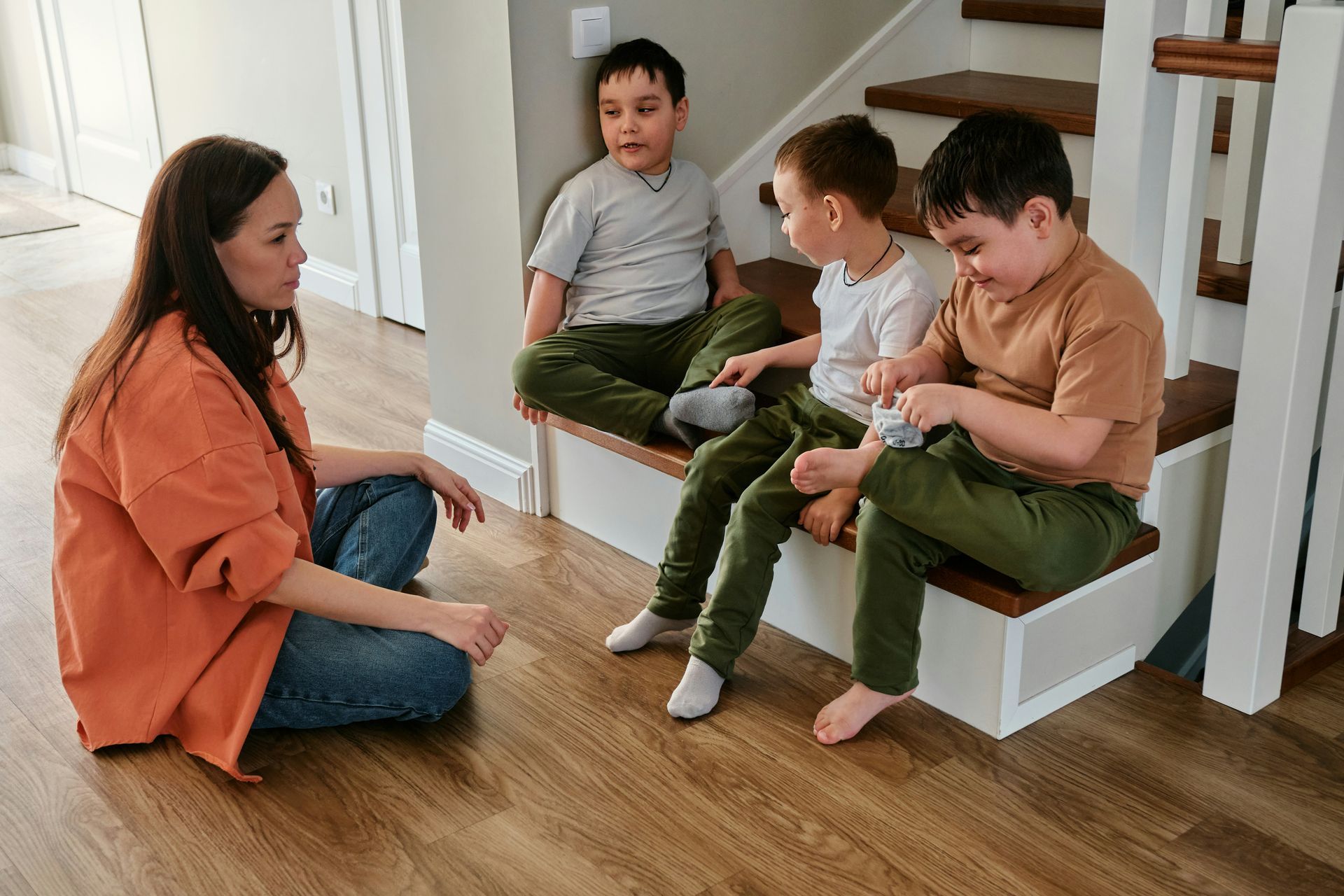
We also have an opportunity to stop this pattern from continuing into the next generation. As parents and grandparents, we can take responsibility for our own behaviour instead of placing our feelings onto a child.
When we make a mistake, we can say, “I was wrong,” or “I blamed you for something that wasn’t your responsibility.” A sincere apology teaches children that adults are accountable too.
We can also correct a child’s behaviour without turning that behaviour into their identity. Instead of calling one child difficult, dramatic, selfish, or the troublemaker, we can talk about what happened in that particular moment. We can listen to every child’s side and base the consequences on what each child was actually responsible for, rather than automatically blaming one child whenever something goes wrong.
When children see adults take responsibility, listen fairly, and repair mistakes, they learn that healthy relationships don’t require one person to become the family problem.
Conclusion: You Get to Choose Something Different
The family scapegoat role isn’t proof that something is wrong with you. It may have developed because you stood out in some way, because one person began treating you as the problem, because others went along with it, and because eventually the pattern became the family’s story about you.
But their story doesn’t have to remain your story. Changing that can happen in very small moments. It happens when you catch yourself apologizing before you know whether you did anything wrong. It happens when you stop explaining yourself to someone who has already decided you are the problem. It happens when you ask yourself, Am I actually responsible for this, or am I automatically picking up the blame again?
And sometimes, it happens in the small moment when you simply choose not to pick the role back up.
I spent most of my life believing I was the problem. Now I understand that the role was never who I was. It was a pattern I learned to live inside. And once you can see the pattern, you can begin choosing something different.
Remember…
See the Pattern. Now What?
Choose to respond differently.
Warm regards,
Gramma Kate